
Hong Kong · August 2026
As artificial intelligence continues to reshape software development, AI coding tools are fundamentally changing how applications are built. Platforms such as Claude Code, Cursor, Codex, and Trae have dramatically lowered the barrier to software creation, enabling product managers, designers, indie hackers, and creators without traditional engineering backgrounds to build web applications using natural language.
Generating code, however, is only one step in the development lifecycle.
PocketBay is an AI-native post-coding platform for vibe coders. Creators keep using the editors and coding agents they already use, while PocketBay handles deployment, managed runtime, data, product operations and distribution—turning local code into a live product that can be operated, discovered and grown after launch.
The Bottleneck of Vibe Coding Is Shifting from “How to Write Code” to “How to Turn Code into a Product”
Over the past few years, AI coding tools have primarily focused on generating code, accelerating development, and improving developer productivity.
With natural language prompts, developers can now rely on AI to design interfaces, implement features, and optimize code in a fraction of the time traditional development required.
But as AI becomes increasingly capable of writing software, a new challenge is emerging:
Once the code is generated, how do you turn it into a real application that people can actually use?
Shipping software requires much more than source code. Applications still need a production environment, networking, databases, security, and ongoing operations before they can be reliably accessed by users.
For traditional engineering teams, these responsibilities are typically shared between backend and DevOps engineers. But as Vibe Coding brings a new generation of creators into software development, many of them need a much simpler path from local code to production.
This is exactly the gap PocketBay aims to bridge.
By automating deployment and infrastructure provisioning, PocketBay removes much of the operational complexity involved in launching applications. Developers can continue building with the AI coding tools they already know while bringing their projects online with a streamlined deployment experience.

Figure caption: PocketBay connects AI Agent-driven deployment workflows with product operations interfaces. Users do not need to switch editors or learn traditional server management.
PocketBay Picks Up Where AI Coding Tools Leave Off
PocketBay is not another IDE or AI coding assistant.
Instead, it fits naturally into developers’ existing workflows. Whether you’re building with Claude Code, Cursor, Codex, Trae, or another AI coding tool, you can continue writing code as usual while PocketBay takes care of deployment, hosting, and application management.
Simply put:
AI coding tools help you build. PocketBay helps you ship.
Developers can deploy local projects directly to PocketBay through their AI coding assistants, eliminating much of the manual work traditionally required to move an application into production.
During deployment, PocketBay automatically analyzes the project’s structure, dependencies, runtime requirements, and framework before provisioning the appropriate environment.
The platform currently supports a wide range of modern web applications, including:
• Static HTML, CSS, and JavaScript websites
• React, Vue, Next.js, Vite, and other frontend frameworks
• Node.js applications and web services
• Python applications built with FastAPI, Flask, or Django
• Containerized web applications running in Docker
PocketBay also supports multiple ways to import projects, including Git repositories and direct project uploads, giving developers the flexibility to work with their preferred development workflow.
From Deployment Platform to Application Operations
Traditional cloud platforms are built around infrastructure. Dashboards typically focus on servers, containers, networking, and resource utilization.
For the growing wave of AI-native developers, however, the questions that matter are different:
• Is my application running reliably?
• Can users actually access it?
• Where are users dropping off?
• What should I improve next?
PocketBay is designed with the application—not the infrastructure—at the center of the experience.
Once an application is deployed, developers can monitor runtime health, traffic, usage metrics, and operational insights from a unified dashboard.
When issues arise, PocketBay surfaces diagnostic information that helps developers quickly identify the root cause. Those insights can then be fed back into AI coding tools, enabling developers to fix issues, iterate faster, and continuously improve their applications.
This creates a new AI-native development loop:
• AI generates the code.
• PocketBay deploys and operates the application.
• Runtime insights drive the next iteration.
As AI-powered software development continues to evolve, thisbuild → deploy → optimize workflow is poised to become the new standard for shipping software.
Built-in PostgreSQL for Modern Web Applications
Most web applications need more than compute—they need persistent data.
PocketBay includes managed PostgreSQL databases, giving every project its own dedicated database without requiring developers to provision or manage separate infrastructure.
With application hosting and databases integrated into a single workflow, developers can move from local development to production faster, without juggling multiple cloud services.
Built-in database management tools also simplify ongoing maintenance, allowing teams to focus on shipping products instead of managing infrastructure.
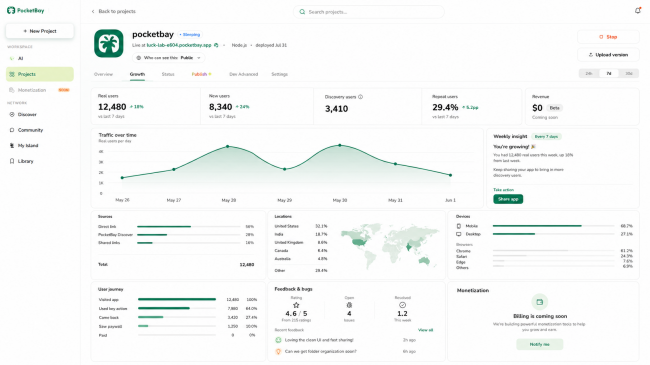
Figure caption: PocketBay’s Growth Console focuses on users, returning usage, traffic sources, user journeys, and operational costs instead of only displaying server metrics.
Rethinking Software Development for the AI Era
Artificial intelligence is reshaping how software gets built.
Not long ago, building a software product required specialized teams responsible for product design, engineering, testing, deployment, and operations. Today, AI is enabling individual creators and small teams to accomplish much of that work on their own.
But writing code is only part of the equation.
As AI continues to lower the barrier to software creation, the focus is shifting beyond code generation toward the entire application lifecycle—from deployment and infrastructure to monitoring, iteration, and long-term operations.
PocketBay is built for this new reality.
Rather than replacing AI coding tools, PocketBay provides the infrastructure layer that connects AI-generated code with production-ready applications, helping developers move seamlessly from building software to running real products.
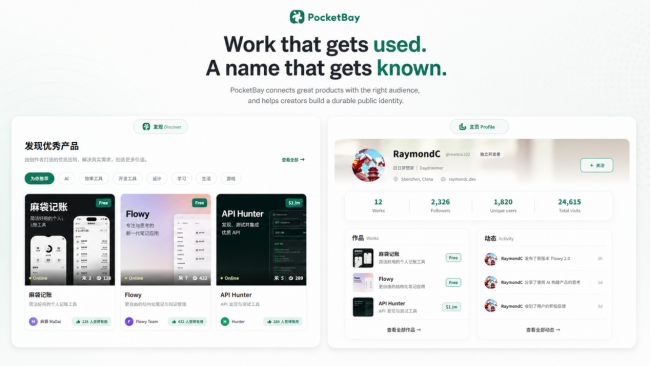
Figure caption: PocketBay connects runnable Discover applications with creator profiles built around real product history.
PocketBay is built on a simple belief: generating code is no longer the hardest part of software development. The real challenge is turning that code into reliable, production-ready products that people can actually use.
As AI-native development continues to evolve, the infrastructure connecting code to production will become an essential part of the modern software stack. PocketBay aims to build that layer.
About Pocketbay
Product Name:
PocketBay
Category:
AI-native Vibe Coding deployment and product operations platform / AI-native post-coding platform
Current Stage:
Public Beta
Operating Entity:
PocketBay Technologies Limited
Official Website:
https://pocketbay.com
About PocketBay:
https://pocketbay.com/about
One-line Deployment:
https://pocketbay.com/deploy
Documentation:
https://pocketbay.com/docs
Contact Email:
support@pocketbay.com
Media Contact
Organization: PocketBay Technologies Limited
Contact Person: Ben
Website: https://pocketbay.com/
Email: Send Email
Country:Hong Kong S.A.R.
Release id:47839
The post PocketBay Bridges the Gap Between AI Coding and Real-World Applications appeared first on King Newswire. This content is provided by a third-party source.. King Newswire makes no warranties or representations in connection with it. King Newswire is a press release distribution agency and does not endorse or verify the claims made in this release. If you have any complaints or copyright concerns related to this article, please contact the company listed in the ‘Media Contact’ section
Disclaimer: The views, suggestions, and opinions expressed here are the sole responsibility of the experts. No Chicago Headlines journalist was involved in the writing and production of this article.